
How Do Pensions And Life Insurance Work Together?


When planning for the later years of life and beyond, two primary financial vehicles will consistently emerge: pensions and life insurance.
In a sense, these two financial products complement each other. A pension supports you from when you retire to the end of your life.
A life insurance policy then pays out upon your death to help support your family after your passing.
However, these two products have some muddy waters around the edges. For example, some pensions will carry over—possibly in limited amounts—to a spouse after you pass.
Life insurance, depending on the kind of coverage you have, may expire and not pay out at all. Then, there are pension-linked insurance policies, which often combine the two in some way.
These two products work together in various ways, depending on your pension and life insurance needs.
Your Pension Supports You—Life Insurance Protects Them. Get a Free Quote Today

State Pensions and Life Insurance Cover
First, let’s talk about the most common scenario: you have a state or SERPS pension accrued from your time working throughout your career. You may or may not also have life insurance cover.
The state pension is more or less guaranteed (as long as you’ve worked to accrue eligible years and/or added additional voluntary contributions) but has a limit to how much it can pay out each week in your retirement.

There are not many ways to link life insurance and your state pension. A state pension is a form of government assistance, calculated based on your working life.
There’s no life insurance component, and no optional life insurance coverage can be added. You can, if you wish, sign up for independent life insurance coverage and use part of your pension to pay for it, but that’s functionally no different from paying for life insurance using any other source of funds you have.
When you reach the end of your life, your state pension ends.
However, your spouse can often inherit a portion of your pension, ranging from 50% to 100%, depending on your circumstances and age. Sometimes this is paid out as a lump sum, which can feel like life insurance but isn’t.
Non-State Retirement Funds and Other Options
Private, third-party pensions are an option for many throughout their working careers. As you go through life, you build up national insurance contributions that pay into the state pension and determine how much state pension you receive when you retire.
If you have excess money and want more than the basic state pension to live on – a reasonable consideration, given how little the state pension is compared to the modern cost of living – you can choose several options for using that additional savings.
One option is a standard savings account that accrues interest. These have no restrictions on how you can access your funds.
Still, they do very little to accrue interest—rates are usually relatively low—and often won’t beat the rate of inflation, effectively losing you purchasing power over time.
Traditional financial investments, such as stocks, bonds, and other investment funds, are also available options. There are many possibilities here, all of which are outside the scope of this guide, so we’re not going to go into detail.
Most commonly, additional funds are paid into a private pension fund. These funds, often referred to as Self-Invested Personal Pensions (SIPPs), are an alternative type of pension managed by a pension fund organisation rather than the government.
These, along with life insurance, are the primary financial vehicles we’ll discuss today.
Life insurance coverage, of course, is an after-the-event benefit for your family. Unlike a pension, it doesn’t pay you anything while you’re alive, retired or not.
When you pass away, the death benefits specified in your policy will be paid out to your beneficiary, whether a spouse, family member, or someone else entirely.
Linking Pensions and Life Insurance Cover
When you have a SIPP or other third-party form of pension, there’s usually a lot more flexibility in interacting with other forms of end-of-life financial planning, including life insurance.
There are generally two ways this works: the life insurance cover is the primary vehicle, or the pension is the primary vehicle.
Pension-primary, secondary life insurance cover
First, let’s discuss the second option: a pension with a secondary life insurance component.
This is similar to using pension funds to pay for life insurance. The difference is when you’re using pension funds to pay for life insurance coverage; you’re not working with the same product or even the same organization.
You’re just rolling two different kinds of late-life financial products into your overall financial planning.
With a linked pension and life insurance system, your SIPP will receive a death benefit or payout after your death.
This typically depends on whether your pension is a defined benefit or a defined contribution plan.
Defined contribution pension schemes
A defined benefit pension scheme is one where, as you build it up throughout your working life, the amount of money grows in line with your contributions.
If you pay £100 per week into a defined benefit scheme for 1,000 weeks, you end up with £100,000 in the defined benefit pension. (Well, that’s not entirely accurate; interest applies; the actual end result is much higher, but we’re talking in simple terms since the exact numbers don’t matter as much as the concepts.)
This benefit pool starts to pay out to you in a regular weekly or monthly pension payment when you retire and start taking your draw-down from the account. In some cases, you can also opt to take the whole thing as a lump sum.
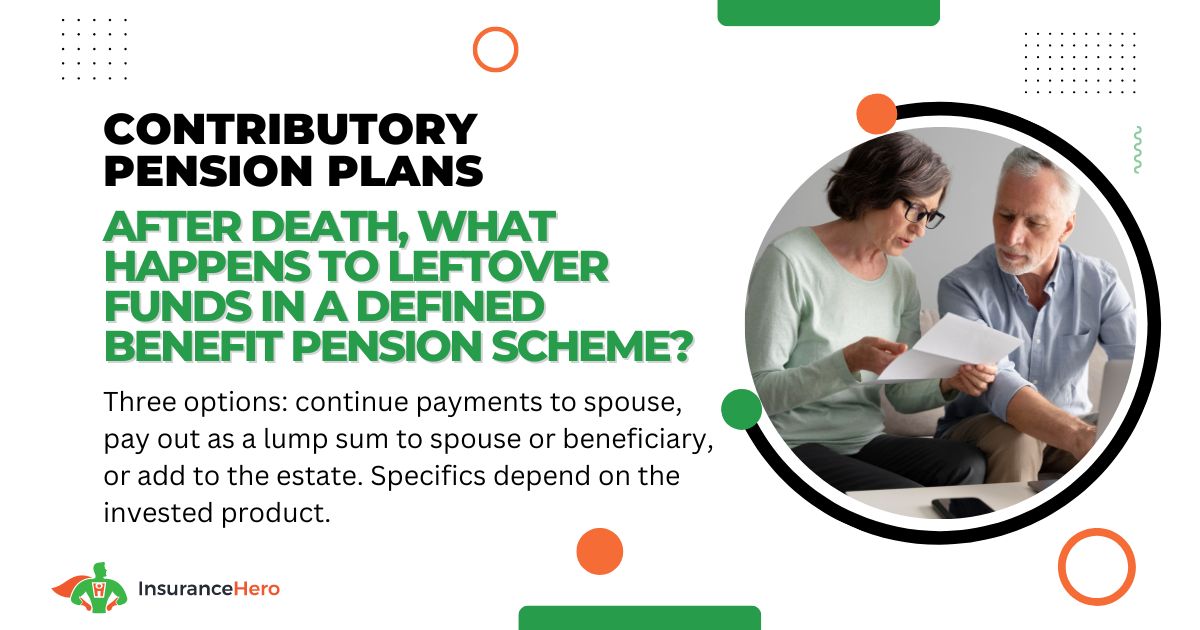
If you make regular payments, some money may remain in the fund when you pass away. This money is yours; it doesn’t disappear or become the company’s property. So, what happens to it?
There are three options:
- First, it can change beneficiaries and continue regular payments to your spouse until the funds are depleted.
- The second is that it can pay out the remainder in a lump sum to your spouse or another beneficiary.
- The third is that it can be added to your estate, similar to any other investment fund.
What happens generally depends on the specifics of the product you’ve invested in.
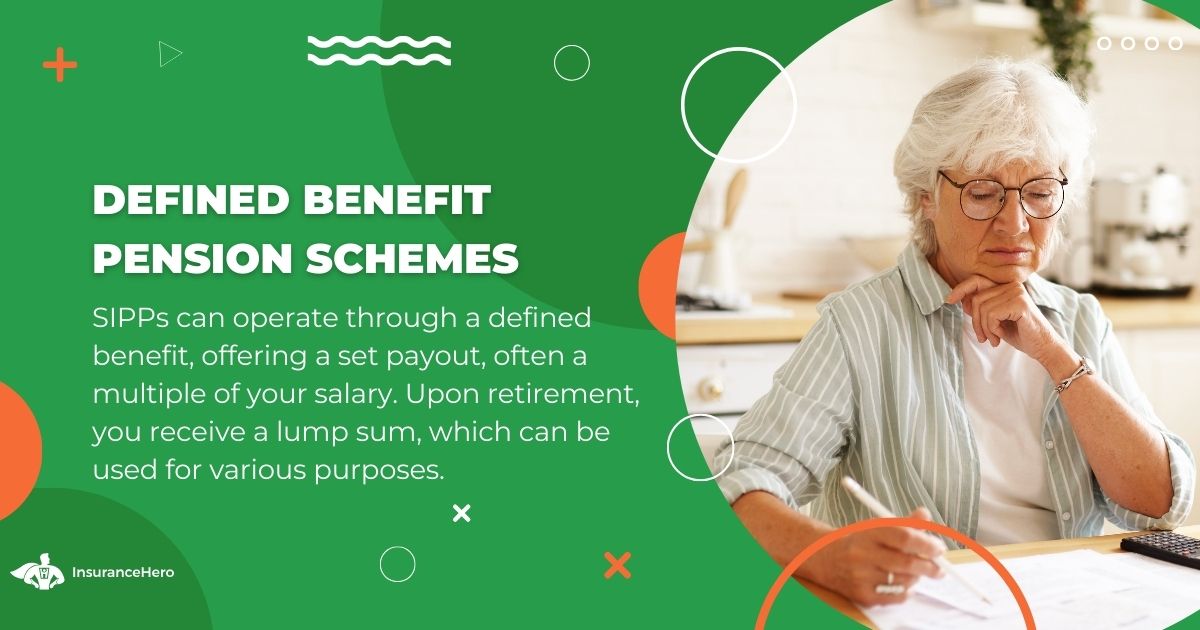
Defined benefit pension schemes
The second way a SIPP can work is through a defined benefit. These have a set amount they are going to pay, often a multiple of what your salary is while you pay into it.
When you retire, you have a pot of 3x or 4x of your salary – or whatever the actual number may be – and that will generally pay out as a lump sum when you retire.
You can then use that to fund another kind of retirement or keep it in savings and use it as necessary.
As you can see, there are numerous options available. In either case, when you have a pension that you’re paying into, it usually won’t have a life insurance rider.
You can get life insurance on your own, and some forms of pension can be treated like life insurance if you pass when they’re still paying out, but they don’t operate quite the same way as life insurance cover will.
Life Insurance with a Linked Pension
The main way life insurance and pension cover are linked is through a life insurance policy that includes a pension as a secondary offering.
Some life insurance policies allow you to add a pension benefit. This is intended to help alleviate the perception that life insurance is worthless.
Unfortunately, many people feel that once they pass away, what happens doesn’t matter, and life insurance coverage is meaningless.
That’s fine if you have no family, no friends, and no one you would want to support after you die financially.
However, the chances of that are relatively low. Even the most unlucky individual can find some charity that might benefit from their passing.

In any case, these kinds of life insurance products often have lower death benefits than other types.
They also have higher costs to maintain that coverage and a valid policy.
This all offsets the fact that while you are still alive and retired, and your policy is active and valid, you receive a pension from your life insurance policy.
The amount this pension offers, the cost of paying into it, and its duration can all vary.
When you pass, assuming your life insurance cover is still valid, and there is no fraud or other reason why your insurance provider would have to deny your claim, any remaining pension fund, as well as the basic life insurance death benefits, will pay out to your spouse, family, or other dependents.
Is It Better to Get Linked Cover?
You’re all but guaranteed your state pension, though it’s often not enough. There’s a reasonable chance you have an ongoing employer pension, secondary pension, or some SIPP. You may also have other savings or retirement accounts.
So, is it worth getting life insurance coverage with a pension attached?
There’s not necessarily a single answer to this question. Some people will find that the maths works out and that the amount they pay into the policy to maintain that pension and cover will be valuable when they retire, allowing them to live at a higher standard of living.
Other people, particularly those who don’t have a reason to invest in life insurance, find that it’s not as financially effective as adding more contributions to the state pension or to a normal SIPP.
Why Life Insurance is Beneficial Even If You Have a Pension
One of the biggest questions people tend to have about life insurance is why they would want it if they have a pension.
A pension-linked life insurance policy allows you the benefits of life insurance and the benefits of an additional pension on top of your state pension and any other retirement funds you have.
This allows you to maintain a higher standard of living in retirement, which enables you to live in nicer accommodations, afford more luxuries, have greater flexibility in your activities, and access private medical care if you prefer.
Depending on the amount you have saved up, you could even end up at the higher end of income in the UK.
Life insurance can be a hard sell for some people. After all, it’s a benefit you don’t see.
But suppose you have a spouse, domestic partner, or another family member. In that case, you want to ensure they are protected and cared for after your passing.
Or if you’re going to build up generational wealth but don’t have something more tangible, like a business you own, to pass down to them, then you can benefit from life insurance.

There are many common myths about life insurance coverage. One of the most persistent is that it’s expensive.
Truthfully, whether you’re dedicating a small amount of your pension fund to paying for life insurance, have a life insurance benefit attached to your pension, or are just privately funding it yourself, life insurance generally isn’t costly at all.
Another common myth is that established life insurance providers will do everything they can to avoid paying out your death benefit.
This varies from provider to provider, but all the UK’s best life insurance providers have a payment rate of over 99%. Insurance providers will refuse a payout only in cases of intentional fraud.
Indeed, combining pensions and life insurance is often a good idea. You can get cheap and valuable life insurance while keeping your standard of living higher, and it’s incredibly easy to do.
For example, we can help you get quotes from all of the best life insurance providers in one simple form. Why not give it a look? You might be surprised at the options available to you.
Steve Case is a seasoned professional in the UK financial services industry, with over twenty years of experience. At Insurance Hero, Steve is known for simplifying complex insurance topics, making them accessible to a broad audience. His focus on clear, practical advice and customer service excellence has established him as a respected leader in the field.
