
Menopause Life Insurance And How To Get Cover


Life insurance is increasingly important as you age. Still, it’s common knowledge that getting good life insurance coverage can seem harder as you age.
This leads many, especially women, to ask about various age-related changes to their bodies and lives and how they might affect their policies. Foremost among these questions is menopause.
Can you get life insurance while going through menopause?
As menopause is an unavoidable fact of life for women as they age, the question becomes whether it makes more sense to get menopause life insurance coverage before it begins or afterwards.
- Menopause, on its own, typically does not need to be declared and does not stop you from being accepted for standard underwritten life cover.
- Premiums are more likely to be influenced by age and any separate health issues (for example, depression, high blood pressure, or cancer history) than by menopause itself.
- If you’re on HRT, most insurers do not treat this as a problem, but you must still answer general medical questions accurately about GP visits and prescriptions.
- If health issues make standard cover difficult, guaranteed‑acceptance over‑50s policies are available that do not ask medical questions.
- Where conditions exist (such as treatment‑induced menopause after a stroke), there may be extra underwriting, higher premiums, or short postponement periods, but cover is still often available.
Compare Menopause Life Insurance Quotes From The UK’s Top Providers, Completely Free Service, Save Money Now

Normal or Atypical Menopause
One of the biggest questions your life insurance provider will ask about menopause is whether or not your menopause is typical.
Most women experience menopause in their early 50s – the average age is 51 years of age – but there are always outliers.
In particular, there are a variety of non-standard causes of menopause, including tumours (both benign and otherwise), associated chemotherapy or radiotherapy, surgical interactions, physical damage, or other hormonal changes.
As long as your experience with menopause falls within the typical average age range – even if it’s a year or two early or late – it isn’t likely to be considered atypical.
Women with atypical menopause, usually much earlier than usual, for a variety of reasons, will likely experience more issues getting life insurance coverage.
However, this isn’t necessarily directly because of early menopause but rather the reason why it’s happening.
Premature menopause as a side effect of radiation therapy for ovarian cancer will impact life insurance rates, but it’s more due to the cancer than the menopause.
Note: one increasingly common reason for atypical menopause is hormone replacement therapy or HRT.
It’s important to know that HRT and a gender transition may impact life insurance rates; however, this is not due to anti-transgender discrimination.
Instead, it’s because several factors involved in gender-affirming care, such as surgery, can impact life insurance.
Additionally, biological and genetic markers that don’t change with hormones are still important for overall lifespan and the risk factors you may face for various diseases throughout your life.
In most cases, however, your life insurance classification is unlikely to change significantly based on these factors.
Menopause brings with it a variety of symptoms, both physical and mental. You will likely see physical changes with periods, and your hormones will change as your ovaries stop producing estrogen and progesterone.
This also often has side effects, including low moods, anxiety, self-esteem issues, depression, impaired memory, difficulty concentrating, hot flashes, insomnia, headaches, weight gain and obesity, muscle aches, joint pain, and more.
These systemic changes can propagate throughout your body and have widespread, often detrimental, impacts.
Other than knowing whether or not your menopause is typical, are there other factors to consider?
Age in General
Perhaps the single most common factor for calculating life insurance rates for various levels of coverage is age.
After all, everyone ages, and the older you are, the more likely you are to have health complications and the more likely you are to pass from those complications.
Since life insurance is, in a sense, a gamble on your longevity, the riskier the bet you are, the more you will need to pay for your cover.
Since menopause, in most cases, doesn’t begin until after the age of 50, you’re already in a semi-advanced state of ageing.
You can still get life insurance coverage – in fact, over-50s life insurance is among the most common types.
But it’s going to cost you a little more than the same cover would if you applied in your 40s, which is more than if you applied in your 30s, and so on.
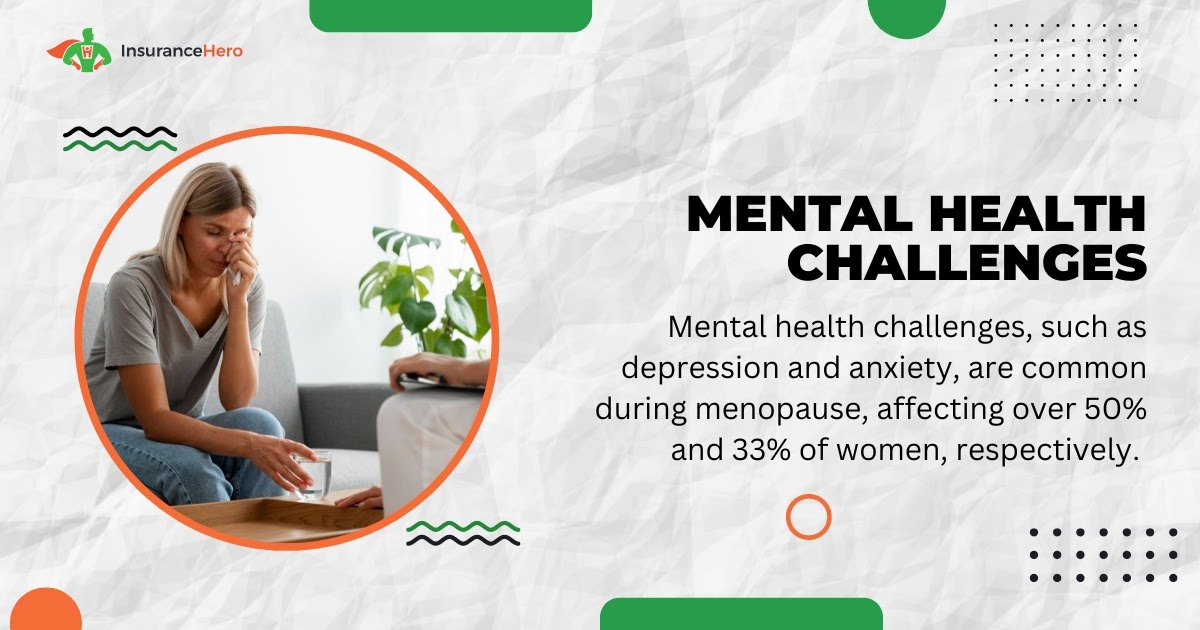
Mental Health Challenges
Another factor that can have an impact – albeit usually a small one – is mental health. Unfortunately, over 50% of women going through menopause report feeling depressed by the changes to their bodies and the implications of those changes.
Another 33% of women report having anxiety because of it. In some cases, these feelings are quite severe and can even lead to medications, therapy, or other treatment.
In most cases, mental health isn’t a huge factor in life insurance.
There may be some associated increase in risk to the insurance provider, but this is generally small enough that it doesn’t impact your coverage.
That said, if you have a history of severe mental illness or have, for example, attempted suicide in the past, it can have a greater potential impact.
Sadly, women in the UK and worldwide don’t get enough support. Menopause, despite being an unavoidable fact of life for women, can often be missed by medical professionals, misdiagnosed based on other symptoms, or even treated improperly.
Poor treatment and misdiagnosis can lead to extraneous tests and medications, which can hurt the overall quality of life.
Physical Changes and Risk Factors
The most significant change in your life insurance will come from the associated side effects and secondary issues caused by both age and menopause.
Women going through and living after menopause are at greater risk of medical conditions such as:
- UTIs
- Migraines
- Diabetes
- Arthritis
- High Cholesterol
- High Blood Pressure
- Obesity
- Osteoporosis
- Heart Disease
Again, though, these are often related to age rather than menopause itself. Men are at risk of many of the same factors at increasing rates as they age.
So, it’s not necessarily a biological or gendered bias in life insurance coverage here, though the associations can sometimes be substantial.
Can You Still Get Life Insurance Cover After Menopause?
Yes, of course. There is virtually no age or condition wherein you cannot get life insurance short of actually on your deathbed.
No matter how old you are or what your overall health conditions are, as long as you aren’t imminently terminal, you’re likely able to get coverage from some provider or another.
Many even offer guaranteed coverage insurance plans, which, as the name implies, ensure your right to coverage.
The older you are, and the worse your health is, the more expensive the cover will be.
Some providers may even make it prohibitively expensive if your situation is bad enough, to disincentivise you from purchasing a plan they’ll more than likely have to pay out in short order.
Even so, you can get quotes from top insurance providers and find something that works for you quickly and easily through our system.
We have contacts with the UK’s top insurance providers and can get you quotes in minutes after you fill out a simple form with your information.
Should You Get Life Insurance Before, During, or After Menopause?
There are three distinct phases of menopause: the start, the progression, and life after menopause.
Regarding life insurance, the three are slightly different: before, during, and after.
So the question becomes, should you get life insurance preferably before, during, or after menopause?
The answer won’t surprise you: the earlier you get life insurance coverage, the better.
The younger and healthier you are, the lower your rates will be, so that you can lock in greater coverage for lower monthly fees, with no issues in your way.
While the best option is to get life insurance coverage early before menopause begins, what happens if you’re already starting to feel the signs?
Should you still apply for life insurance immediately, or should you consider waiting?
This one is a slightly trickier question to answer. It primarily all comes down to whether or not you’re experiencing significant, life-altering changes with menopause or if it’s a relatively “light” incidence for you.
Some women experience much greater symptoms than others, while some get off quickly. In rare cases, menopause can last up to fifteen years, and the symptoms can be extreme.
If you’re experiencing abrupt health issues like sudden diabetes, you may consider waiting in case they go away.
Much like pregnancy, menopause can induce changes that, once they settle down and your body adjusts, can disappear.
If you apply for life insurance coverage when experiencing these problems, they will negatively impact your life insurance.
If you wait a bit, you will still need to report that you had them, but recovering from them will help make your case for lower premiums.
In almost all cases, it’s best to apply as soon as possible. However, if your health improves later, you can always consider a readjustment.
Can You Make a Claim on Your Life Insurance?
In the vast majority of cases, a life insurance claim is only made by your beneficiary after your passing.
You aren’t generally the person making the claim on your own life insurance cover.
However, there are some circumstances where you may be able to claim while you’re still alive.
You may receive your payout early so that you can help prepare for your own end-of-life care or funeral preparations and take steps to arrange the protection of the money for your beneficiary.
For example, you might have a young child and want to protect them with your payment via a trust rather than just giving the money to them; that can potentially be done with a payout early while you’re still alive.
The primary reason why you can make a claim early is if you’re diagnosed with a terminal illness and, despite modern medical science, you don’t have much time left.
Terminal cancer and other illnesses are the most common causes of this early claim being accepted.
Unfortunately, as much as menopause often includes a variety of symptoms that make you feel like you’re dying, you aren’t dying, and menopause isn’t a terminal illness.
Therefore, using menopause as the basis for a life insurance claim isn’t going to work. You would file the paperwork, the insurance provider would ask why, you would respond with menopause, and they would deny the claim.
There is one way that menopause can lead to a life insurance claim, but it’s also not before your passing.
Since one of the symptoms of menopause is depression, and untreated depression can lead to a variety of issues, including suicidal ideation and tendencies, suicide is not entirely out of the question.
You aren’t the one claiming in this case, of course.
Also, many life insurance policies have riders that explicitly refuse to pay out during a suicide to prevent abuse of the system. This depends on the specific policy, so being informed is good.
⚕️ MEDICAL INFORMATION NOTICE
The female medical condition information Insurance Hero provides on this page is for general educational purposes only and should not be considered medical advice.
For your specific medical questions:
- Consult your GP or specialist
- Contact NHS 111 for health concerns
- Visit www.nhs.uk for trusted medical information

Life Insurance No Medical Exam Or Questions Required
Are you looking for a life insurance no medical exam policy? Did you know that, in many cases, insurers do not require a…
Is Life Insurance With A Heart Condition Possible?
Can I Get Life Insurance If I Have A Heart Condition Or A Stent? Providers typically ask detailed questions abo…
HIV Life Insurance, Can I Get Cover In 2026?
Many people think life insurance is unavailable to those suffering from HIV. The good news is that getting life insuranc…
Life Insurance For Disabled Adults And People In The UK
Insurance Hero has tried hard to find the best life cover for those with a disability in the UK. From that list…
Cancer Life Insurance And Critical Illness Quotes
When a medical tragedy strikes, knowing there is financial support for you and your family can bring a lot of relief to …
Anxiety Life Insurance Cover In 2026
In the UK, one in four people will experience some mental health issue each year, with the most common conditions encoun…
Diabetes Life Insurance Cover
Some people assume it is hard to secure life insurance with some pre-existing condition. This includes diabetes life ins…
Asthma Life Insurance Coverage Guide
Have you been suffering from Asthma and considering life insurance coverage? Maybe you’ve been turned down before and ar…
Life Insurance With High Cholesterol
High cholesterol and high blood pressure affect almost 30 per cent of the population. If left untreated, these condition…
Life Insurance With High Blood Pressure
Can someone with high blood pressure get life insurance? The simple answer is yes. We work with UK insurers that offe…
Epilepsy Life Insurance Specialist Cover Options
Pre-existing illnesses are more common now than a few decades ago. Insurance Hero is an insurance company speci…
Trusted High BMI Life Insurance For Overweight People In 2026
The average individual has a Body Mass Index (BMI) of 23. BMI is the ratio of height to weight. Even individuals…
Do Any UK Companies Offer Female Cancer Life Insurance?
Cancer is a worldwide medical issue. More than 335,500 people in the UK will be diagnosed with cancer in 2025, according…
Trusted Life Insurance For Recovering Alcoholics In 2026
Life insurance is an essential product that helps individuals support their families, even when they are no longer aroun…
Life Insurance For Smokers – Lower Rates Are Possible
Estimates in the UK still indicate over 9 million people smoke despite smoking restrictions in indoor public places. Smo…
Impaired Risk Life Insurance Cover
It is well-known that health status affects the premiums offered by most life insurance carriers. If insurance …
Bipolar Disorder Life Insurance Coverage
According to Bipolar UK, an organisation that provides support for people affected by bipolar disorder, 1.3 million peop…
Life Insurance With Lupus What Are Your Options?
Are you living with lupus and worrying about how it affects your chances of getting life insurance? You’re not …
Life Insurance With Crohn’s Disease 2026
Crohn’s disease is one of the main inflammatory bowel diseases that affects 1 in every 650 people in the UK. …
A Guide To OCD Life Insurance
Navigating the world of OCD life insurance (Obsessive-Compulsive Disorder ) might seem challenging, but don’t worry – …
MS Life Insurance Multiple Sclerosis Life Cover
Insurance Hero offers MS Life Insurance plans that suit your lifestyle without restrictions. Individuals diagnos…
Is It Possible To Get Life Insurance After A Stroke?
Few things bring the fragility of life and the inevitability of mortality into focus quite like a major health event. …
Skin Cancer Life Insurance Cover, Is It Possible?
Cancer can be a devastating illness, and it can be difficult to discuss primarily because it’s not just one disease. …
Does Genetic Testing Affect Life Insurance Premiums?
A few decades ago, the idea of having your genetics tested was firmly in the realm of science fiction. Then, in 1990, a …
Low BMI Life Insurance Cover For Underweight People
You can often secure life insurance coverage even if you are underweight or have a low BMI. Many insurance companies …
Steve Case is a seasoned professional in the UK financial services industry, with over twenty years of experience. At Insurance Hero, Steve is known for simplifying complex insurance topics, making them accessible to a broad audience. His focus on clear, practical advice and customer service excellence has established him as a respected leader in the field.
