
Low BMI Life Insurance Cover For Underweight People


You can often secure life insurance coverage even if you are underweight or have a low BMI.
Many insurance companies offer policies for people with lower body mass indices, though you must disclose your situation.
While there isn’t a distinct policy labelled “underweight life insurance” or “low BMI life insurance,” the term refers to life insurance purchased by people with lower body weight.
Low BMI and Life Insurance in Summary:
It’s important to understand how BMI, or body mass index, affects life insurance. BMI, or Body Mass Index, is a measure derived from height and weight that estimates health risks.
Insurance Hero can help you find the most comprehensive and cost-effective underweight life insurance policies.
Here’s what we’ll cover:
- BMI Impact: Life insurance companies consider BMI among several factors that determine risk. Low and high BMIs can influence premiums and coverage options.
- Health Risks: A BMI that falls outside the normal range may be associated with various health problems, affecting insurance decisions.
- Customisable Cover: Regardless of your BMI, you can discover various cover options by comparing quotes from providers like Insurance Hero.
Low BMI? Compare The Top UK Insurers · No Obligation · Free Quote Below


Life Insurance for Underweight BMIs
While obesity is a significant issue around the world, BMI has a lower bound, and being underweight can be just as bad in some ways as being overweight.
Being underweight can affect life insurance because, much like being overweight, being underweight can be associated with certain illnesses or disorders.
Some medical conditions and treatments, such as chemotherapy, for example, can lead to being underweight and impact your life insurance. Eating disorders, similarly, can have a negative impact.
Suppose your BMI is below the normal range. In that case, your low-BMI life insurance provider will likely want to ask additional questions, such as whether you’ve been diagnosed with diseases or disorders that could cause it, or whether there’s a physical reason that could explain it.
They will then decide what kind of premiums and what level of cover they can offer you.
Is Life Insurance Worthwhile if You’re Underweight?
No matter your health situation, life insurance can be an excellent way to provide peace of mind and secure your loved ones’ future should you pass away.
Like overweight insurance, if you’re underweight but address underlying issues and gain weight to reach a healthy BMI, you can inform your provider and potentially get an adjusted premium.
In most cases, you will end up with slightly more expensive coverage unless you have serious health issues, which could be either significantly more expensive or denied.
Again, this varies from provider to provider, so you’ll want to compare life insurance quotes to ensure you’re getting the best possible coverage at the best price.
Life insurance works by evaluating your overall health according to various known factors and placing you in a particular risk bracket.
This bracket primarily determines your insurance premiums.
It works as a way to categorise risk. People with worse overall health, according to a variety of metrics, are, statistically speaking, more likely to die sooner than people in better health.
While you might defy the odds individually, the statistics bear out across the UK population as a whole.
Insurance providers use these statistics with term life insurance policies to manage risk. After all, a provider makes a net profit if someone outlives their coverage.
This is why it’s better to have good health when you apply for life insurance coverage and to do so as early as possible while you’re still young. There is no greater determinant of health outcomes than age.
That said, you may know that certain aspects of health are either off-limits or cannot be factored into your evaluation.
Genetic testing, for example, is currently not allowed outside of very specific cases, which you can read about here.
So, is BMI one of the factors that matters, or is it something the life insurance companies can’t ask for or use?

What is BMI?
BMI stands for Body Mass Index. It’s a relatively simple calculation: take your weight and divide it by your height, in square meters.
Here’s the example the NHS gives:
For example, if you weigh 70kg (around 11 stone) and are 1.70m (around 5 foot 7 inches) tall, you work out your BMI by:
squaring your height in metres: 1.70 x 1.70 = 2.89
dividing your weight in kilograms: 70 ÷ 2.89 = 24.22
Your result will be displayed to one decimal place, for example, 24.2.
You can also calculate in imperial units, with weight in pounds and height in inches squared.
Fortunately, you don’t need to do the maths yourself. The NHS provides its own calculator here, and many other calculators are available online.
The idea of BMI is that you can’t necessarily be called overweight or underweight based solely on your weight.
Someone over 2m tall and 1.3m tall, both weighing the same, will have vastly different body shapes and overall health at that weight.
The basic numbers aren’t adequate on their own, but since weight impacts overall health, something was needed to more accurately estimate its impact and provide a numerical indicator of where you stand on the spectrum.
BMI is considered normal if it’s between 18.5 and 25. Anything under 18 is considered underweight. Meanwhile, a BMI between 25 and 30 is considered overweight, and anything over 30 is considered obese.
This range was built on the actuarial tables used by groups such as life and health insurance providers, so those using it come full circle. The further from the normal BMI range, the greater the risk of adverse health impacts.
For example, all of these have been correlated with a high BMI:
- Diabetes
- Certain Cancers
- Arthritis
- Liver Disease
- Hypertension
- High Cholesterol
- Sleep Apnea
All of these, additionally, can lead to further adverse health impacts and, eventually, potentially even death.

The Drawbacks of BMI
Given all the weight put on BMI, it’s not a perfect metric. There are many factors other than weight and height that can impact health, and even skew the results of BMI.
Muscle is denser than fat. This means that someone who is relatively healthy and works out frequently can have a BMI that classifies them as obese, even though they’re much more nutritious than someone in a more normal BMI range because of their dedication to fitness and exercise.
BMI changes during pregnancy. If you’re carrying a baby, your BMI will be higher. Pregnancy also has health impacts, of course, but not in the same way as obesity. This is why most BMI calculators say not to use them if you’re pregnant because they’re unreliable at that point.
Physical conditions can skew the results. An easy example would be an amputee; someone losing a leg will be much lighter for their height and would consequently have either a BMI more in the normal range despite obesity or an underweight BMI despite being in the normal range otherwise.
This is just one example; many such factors can skew the results.
BMI doesn’t predict or account for other illnesses. It can’t even predict, let alone cause, the diseases linked to it.
People who are pretty high on the BMI charts can still have normal blood pressure, blood sugar, and even cholesterol; meanwhile, otherwise healthy-looking individuals can have underlying diseases.
BMI doesn’t appropriately consider race. The original BMI charts and the idea of what is normal were developed primarily on white patients.
Studies have shown that using the same BMI charts leads to overestimating the risk of problems in black individuals and underestimating it in Asian individuals.
These are just some of the issues with BMI.
However, it is important to note that BMI is not the only measure used. On its own, it’s a lousy metric for evaluating health. You can’t look at someone’s BMI in the abstract and judge their situation.
However, when used in conjunction with other test results and metrics, such as blood tests, fitness and activity levels, and other information typically asked about on health screeners, it can contribute to a more robust overall picture of one’s health.
How BMI Impacts Life Insurance
First, let’s answer the question: Can life insurance companies use BMI in their calculations?
The answer is yes. Even if they weren’t allowed to ask, your height and weight are valid information to ask, and from there, they could calculate it themselves, which is precisely what they did many years before BMI as a public metric took hold.
Nothing prohibits insurance firms from using BMI as one of the factors in their calculations.
The second question, then, is whether insurance providers use BMI. The answer is yes because, despite the flaws above, it remains an essential metric that indicates certain health risks.
But again, they don’t use it in isolation; it’s one of many factors considered in a complex set of actuarial tables that determine risk.
How does BMI impact your life insurance?
- An elevated BMI can lead to higher insurance premiums.
- A significantly elevated BMI can lead to being denied coverage, depending on the provider’s limits.
- The insurance provider might stipulate specific riders or add-ons to cover or exclude/include specific causes of death.
Again, though, BMI is just one of many factors considered. It’s also one of the easiest to adjust, so if you have a high BMI and decide to lose weight to bring it into the normal range, you may be able to request a reassessment and lower your premium.
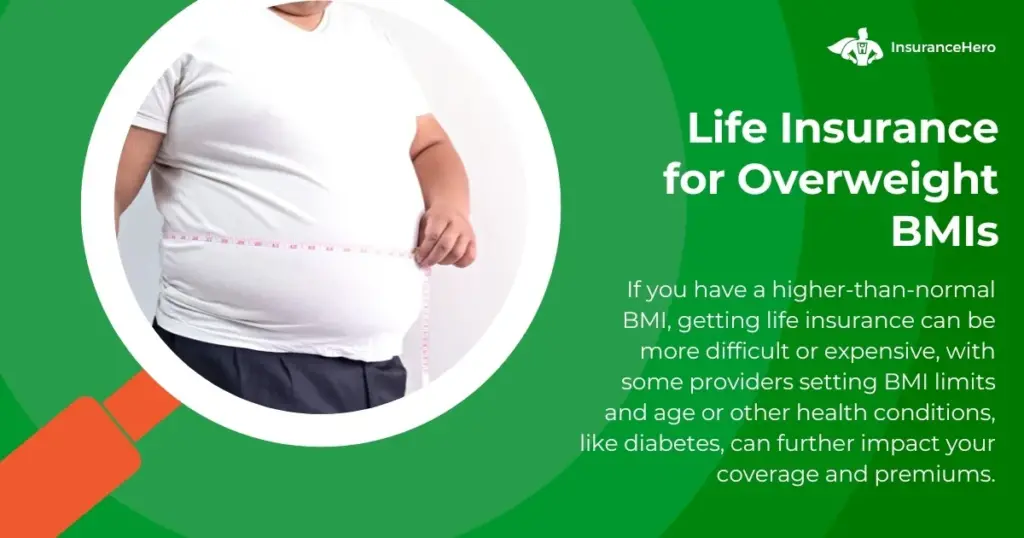
Life Insurance for Overweight BMIs
If you are overweight or have a higher-than-normal-range BMI, you may find it harder or more expensive to get the overweight life insurance you want from the providers you reach out to.
Some providers put limits on the coverage they will offer. For example:
- The Exeter won’t cover anyone with a BMI over 53.
- Royal London won’t cover anyone with a BMI over 46.
- LV= won’t cover anyone with a BMI over 46.
- AIG won’t cover anyone with a BMI over 46.
- Guardian won’t cover anyone with a BMI over 44.
For the most part, the major insurance providers are all in the same range.
Two other factors also influence this. Many of these are age-gated as well. To use The Exeter as an example, the limit is a BMI of 51 for anyone under 44; for ages 45-59, it’s 53, and for anyone over 60, it’s 41.
The older you are, the more likely your BMI is to affect your health, increasing the risk to the insurance provider.
The second factor is other health conditions. For example, if you have a high BMI and have also been diagnosed with diabetes, you will likely find it harder to get life insurance coverage, and if you do, it will be more expensive.
Simply put, this is because your health conditions put you at greater risk of dying during the term of your life cover, leading to a payout of benefits and the corresponding financial loss to the insurance provider.
In a sense, you can consider BMI status a multiplier on other health conditions and statuses that would be either good or bad on the actuarial tables.
Is Life Insurance Worthwhile if You’re Overweight or Obese?
Life insurance can be more expensive depending on the amount of coverage you want.
At the same time, though, you’re statistically more likely to end up getting that payout to your loved ones, so if securing their future is something that weighs heavily on your mind as well as your body, getting life insurance – even at a higher price point – is a good idea.
Fortunately, life insurance isn’t going to refuse to pay out because of your BMI, as long as you’re honest with them when you’re signing up.
Most modern life insurance companies have a very high rate of successful claims because they’re thorough in their investigations and keenly aware of the fraud that can occur, stopping it before it escalates.
What’s the best life insurance for someone with a high BMI?
That varies depending on your needs and other circumstances. Instead of shopping alone, you can use our service to compare life insurance quotes from the UK’s best providers.
There’s no cost or obligation; fill out our form, and we’ll deliver the quotes for you to evaluate. We’re also always standing by to answer any questions you may have, so you can get the cover you deserve.

Life Insurance No Medical Exam Or Questions Required
Are you looking for a life insurance no medical exam policy? Did you know that, in many cases, insurers do not require a…
Is Life Insurance With A Heart Condition Possible?
Can I Get Life Insurance If I Have A Heart Condition Or A Stent? Providers typically ask detailed questions abo…
HIV Life Insurance, Can I Get Cover In 2026?
Many people think life insurance is unavailable to those suffering from HIV. The good news is that getting life insuranc…
Life Insurance For Disabled Adults And People In The UK
Insurance Hero has tried hard to find the best life cover for those with a disability in the UK. From that list…
Cancer Life Insurance And Critical Illness Quotes
When a medical tragedy strikes, knowing there is financial support for you and your family can bring a lot of relief to …
Anxiety Life Insurance Cover In 2026
In the UK, one in four people will experience some mental health issue each year, with the most common conditions encoun…
Diabetes Life Insurance Cover
Some people assume it is hard to secure life insurance with some pre-existing condition. This includes diabetes life ins…
Asthma Life Insurance Coverage Guide
Have you been suffering from Asthma and considering life insurance coverage? Maybe you’ve been turned down before and ar…
Life Insurance With High Cholesterol
High cholesterol and high blood pressure affect almost 30 per cent of the population. If left untreated, these condition…
Life Insurance With High Blood Pressure
Can someone with high blood pressure get life insurance? The simple answer is yes. We work with UK insurers that offe…
Epilepsy Life Insurance Specialist Cover Options
Pre-existing illnesses are more common now than a few decades ago. Insurance Hero is an insurance company speci…
Trusted High BMI Life Insurance For Overweight People In 2026
The average individual has a Body Mass Index (BMI) of 23. BMI is the ratio of height to weight. Even individuals…
Do Any UK Companies Offer Female Cancer Life Insurance?
Cancer is a worldwide medical issue. More than 335,500 people in the UK will be diagnosed with cancer in 2025, according…
Trusted Life Insurance For Recovering Alcoholics In 2026
Life insurance is an essential product that helps individuals support their families, even when they are no longer aroun…
Life Insurance For Smokers – Lower Rates Are Possible
Estimates in the UK still indicate over 9 million people smoke despite smoking restrictions in indoor public places. Smo…
Impaired Risk Life Insurance Cover
It is well-known that health status affects the premiums offered by most life insurance carriers. If insurance …
Bipolar Disorder Life Insurance Coverage
According to Bipolar UK, an organisation that provides support for people affected by bipolar disorder, 1.3 million peop…
Life Insurance With Lupus What Are Your Options?
Are you living with lupus and worrying about how it affects your chances of getting life insurance? You’re not …
Life Insurance With Crohn’s Disease 2026
Crohn’s disease is one of the main inflammatory bowel diseases that affects 1 in every 650 people in the UK. …
A Guide To OCD Life Insurance
Navigating the world of OCD life insurance (Obsessive-Compulsive Disorder ) might seem challenging, but don’t worry – …
MS Life Insurance Multiple Sclerosis Life Cover
Insurance Hero offers MS Life Insurance plans that suit your lifestyle without restrictions. Individuals diagnos…
Is It Possible To Get Life Insurance After A Stroke?
Few things bring the fragility of life and the inevitability of mortality into focus quite like a major health event. …
Menopause Life Insurance And How To Get Cover
Life insurance is increasingly important as you age. Still, it’s common knowledge that getting good life insurance cov…
Relevant external resources:
- https://www.nhs.uk/conditions/malnutrition
- https://www.citizensadvice.org.uk/consumer/insurance/types-of-insurance/illness-insurance1/
Steve Case is a seasoned professional in the UK financial services industry, with over twenty years of experience. At Insurance Hero, Steve is known for simplifying complex insurance topics, making them accessible to a broad audience. His focus on clear, practical advice and customer service excellence has established him as a respected leader in the field.
